Advisor equity: write the standard before you pick the advisor
Founders I advise keep sending me a version of the same message. Someone senior has offered to help, what do we give them. It always arrives after the conversation has already happened, and usually after a number has been said out loud in a room.
That order is the problem. By the time you are deciding what an advisor gets, you are deciding it about one specific person you like, who has just spent an hour being useful to you for free. You will be generous. Then you do it again with the next person, at a different number, on a different vest, and a year later you have five advisors on five different deals and no principled way to say no to the sixth.
So the first thing I tell founders now: decide the tiers before you decide the people. Write it once, circulate it to your co-founders, and every later conversation collapses into a sentence. “We do this at Strategic, here is what that means.” People argue with a number. Almost nobody argues with a policy that existed before they walked in.
Start from FAST, then see what it leaves out
The Founder Institute’s FAST agreement (Founder / Advisor Standard Template) is the one widely used public document here. It is free, it is short, and you should read it before you write anything of your own.
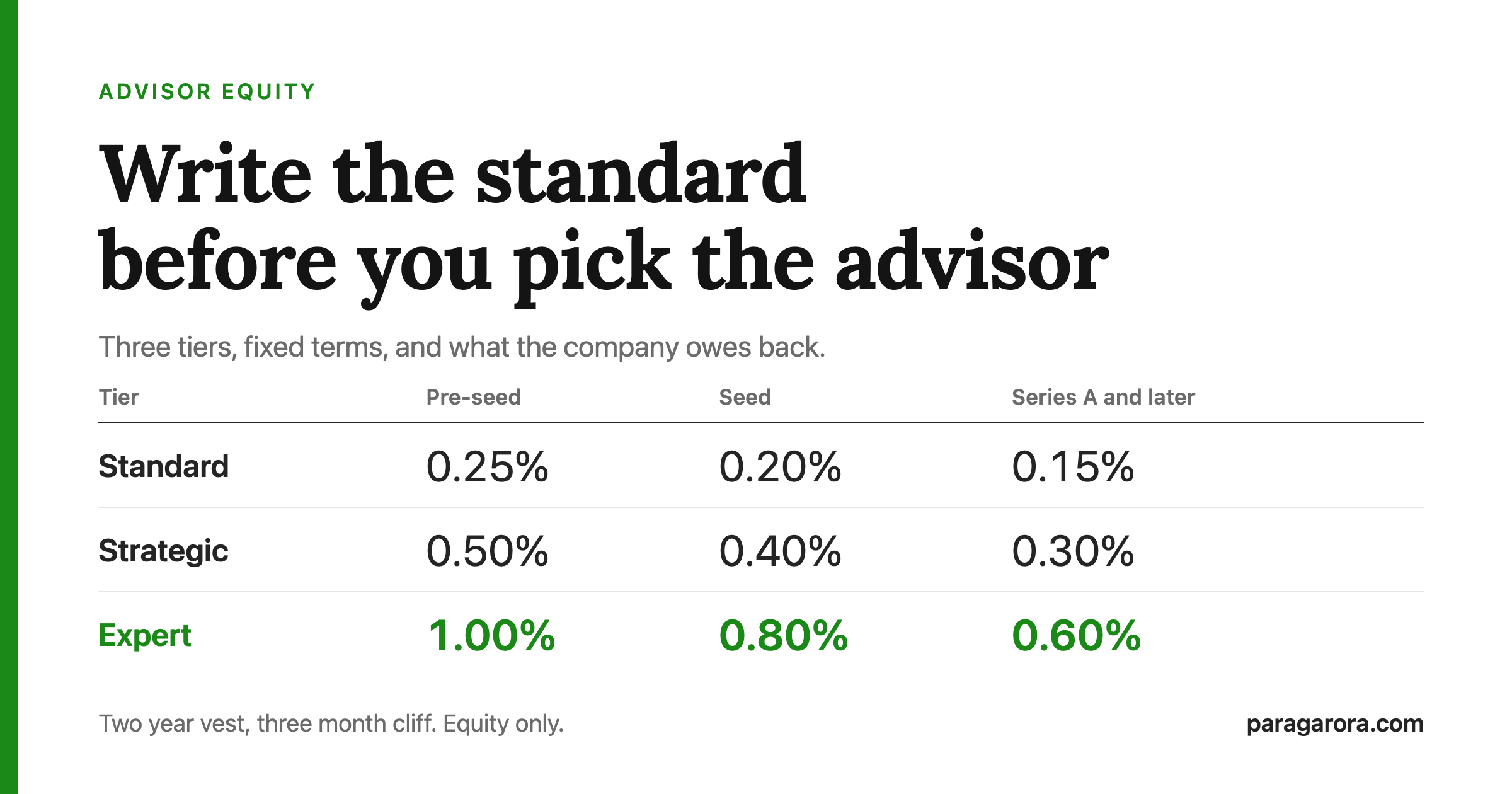
What it gets right. Advisors are paid in equity and never in cash. Options vest over two years with a three month cliff, so a relationship that dies in month two costs you nothing. And the grant shrinks as the company gets later: idea stage pays more than Series A for the same work, because the risk the advisor is taking is not the same risk.
What it does not do, which caught me out. FAST names a Strategic tier sitting between Standard and Expert, but it does not publish percentages for it. Standard is 0.25 / 0.20 / 0.15 and Expert is 1.00 / 0.80 / 0.60 across the three stages. The middle row you will see quoted all over the internet as 0.50 / 0.40 / 0.30 is convention, not FAST. I use those numbers and I think they are right, but say that out loud instead of citing it as if it came from the source.
FAST is also explicit that it is not for project work. If what you actually want is someone to build the data pipeline or run the hiring round, that is a contractor, and it needs a scope and a fee and a different document. Dressing up work for hire as advisory is how you get to a disputed grant and an ugly conversation about whether any of it vested.
Write the company’s side down too
Every advisor agreement I have read binds the advisor. Time, confidentiality, IP, non-disparagement, what happens to the options if they go quiet.
Very few of them bind the company, and the company side is the side that fails. The monthly session gets booked with two days of notice. The question lands cold at 11pm with no numbers attached and a request for an answer by morning. And the common one: the advisor gives a view, the founders do something else, and nobody ever tells them. Three months of that and your advisor has stopped reading your emails. The equity keeps vesting regardless.
So the standard I hand founders has a second table listing only what the company owes. A week of notice with an agenda. Context before the question, meaning the numbers and the documents, not the question on its own. An answer on what you did with the advice, including when you ignored it. That last one does more work than it looks like it should: being overruled is fine, being overruled in silence is what makes senior people quietly leave. Then one named founder who owns the relationship, and an honest ending if it is not working, said out loud and done under the notice clause rather than left to fade.
The terms I would not vary
Equity only. The moment cash enters, you are buying consulting, and the price goes up every year.
Two year vest, three month cliff, monthly after that.
Percentages of the fully diluted share capital at the date of grant, written into the document in those words. Otherwise somebody discovers later that they were quoted against a different denominator.
Thirty days of notice, both directions, with no cause required.
A cap on total advisor equity across everybody, not just per person. Two percent is a reasonable place to start. The tiers control what one advisor gets; only the cap controls what all of them get, and the cap is the thing that actually protects the cap table.
Where the template stops helping
Cross border grants. If the advisor sits in India and the options come from your Singapore holding company, you are in exchange control and perquisite tax, and no template covers that. India’s overseas investment route for shares is written around employees and directors, and an outside advisor is usually neither. Same problem if the advisor also invoices you through their own company, which is a related party disclosure your next investor will ask about. Get a CA and a lawyer in the relevant country before the grant, not after you have signed it.
Everything above that line is policy you can decide in an afternoon. Everything below it is advice you pay for.
The one page version
Three tables: the tiers and what each one commits to in hours, what the company owes in return, and the grant percentages by stage. No company names in it, nothing specific to anyone. Take it, change the numbers to the ones you believe, and send it to your co-founders before the next person offers to help.
If this was useful, follow me on X for more.
Follow @paragarora on X