Launch Attention, Not Utility
Reddit was a fake community for months before real users arrived. Dropbox generated 75,000 beta signups with a demo video of a product that did not yet fully exist. Gmail created artificial scarcity through invite codes that traded on eBay for $100-150 each. Slack hit 8,000 invitation requests on day one from a single coordinated press push.
None of these were accidents. They were manufactured moments.
The pattern across every major consumer platform is nearly identical: the first users did not discover the product through its utility. Utility cannot reach someone who does not know the product exists. Attention brought them to utility.
The Misallocation
Andrew Chen’s data on product roadmaps shows that only 6 out of 33 items in a typical startup’s roadmap target non-users versus active users. Founders spend roughly 80% of product effort on retention features for existing users, and 20% on acquisition for new users. The inversion: pre-launch, you have no existing users to retain.
The Hacker News thread titles tell the same story: “I spent months building an app and now I don’t know how to get users.” “I spent 8 months building a Data Hub that nobody used, so I pivoted.” This failure mode is so common that “a distribution framework for founders who can build but can’t sell” exists as its own product category.
56% of startups fail due to marketing problems, not product problems.
The Seven Mechanisms
Lenny Rachitsky’s research across every major consumer app’s early growth identifies seven categories that account for nearly every successful launch:
- Going offline to target users directly (Tinder at USC, DoorDash physical flyers, Snapchat at malls)
- Finding users in online communities (Dropbox on Digg, Netflix DVD forums)
- Leveraging personal networks (Facebook at Harvard, LinkedIn with high-status professionals)
- Creating exclusivity and FOMO (Gmail invites, Superhuman waitlist, Pinterest invite-only)
- Engaging influencers (Twitter via Om Malik’s blog post, Product Hunt launch)
- Securing press coverage (Airbnb at the DNC, Slack’s coordinated press day)
- Building pre-launch communities (Product Hunt’s email list, Superhuman’s 180,000-person waitlist)
Every single one of these is an attention-creation strategy, not a utility-delivery strategy. None of them involve making the product better. All of them involve manufacturing a moment of awareness.
The Paradox
The most counterintuitive finding: some of the most successful products launched before they were fully built.
Dropbox’s demo video generated 70,000-75,000 beta signups with a product that did not yet fully exist. The video demonstrated utility so compellingly that the attention was generated before utility could be delivered. Superhuman built a 180,000-person waitlist before most people could use the product. Product Hunt was announced via an email list before the platform was built.
Attention can be manufactured for a product that does not yet exist. Utility cannot. This is why attention must come first.
What Attention Without Utility Looks Like
The counter-evidence matters. Secret had 15 million users and shut down in 2015 when usage collapsed. Yik Yak had 1 million users in 6 months and shut down in 2017. Clinkle raised $25 million on manufactured attention and shut down in 2016.
All three had successful attention strategies. None had utility that generated retention.
The Slack example provides the synthesis: coordinated press generated 8,000 invitation requests on day one. But the product retained 93% of teams who exchanged 2,000 messages. The attention moment brought users to the door; utility kept them inside.
Attention is necessary but not sufficient. The optimal strategy is minimum viable utility sufficient to hold early users, then heavy investment in the attention mechanism that brings them.
The Cost Structure Explanation
Marc Andreessen’s 2011 analysis explains why distribution is now the bottleneck: the cost of running an internet application fell from $150,000 per month to $1,500 per month, a 99% reduction. When anyone can build, the competitive advantage shifts entirely to distribution. Building is no longer differentiating. Getting attention is.
Herbert Simon wrote in 1971: “a wealth of information creates a poverty of attention.” He was describing the world founders now operate in. The abundance is product; the scarcity is the moment someone first notices you exist.
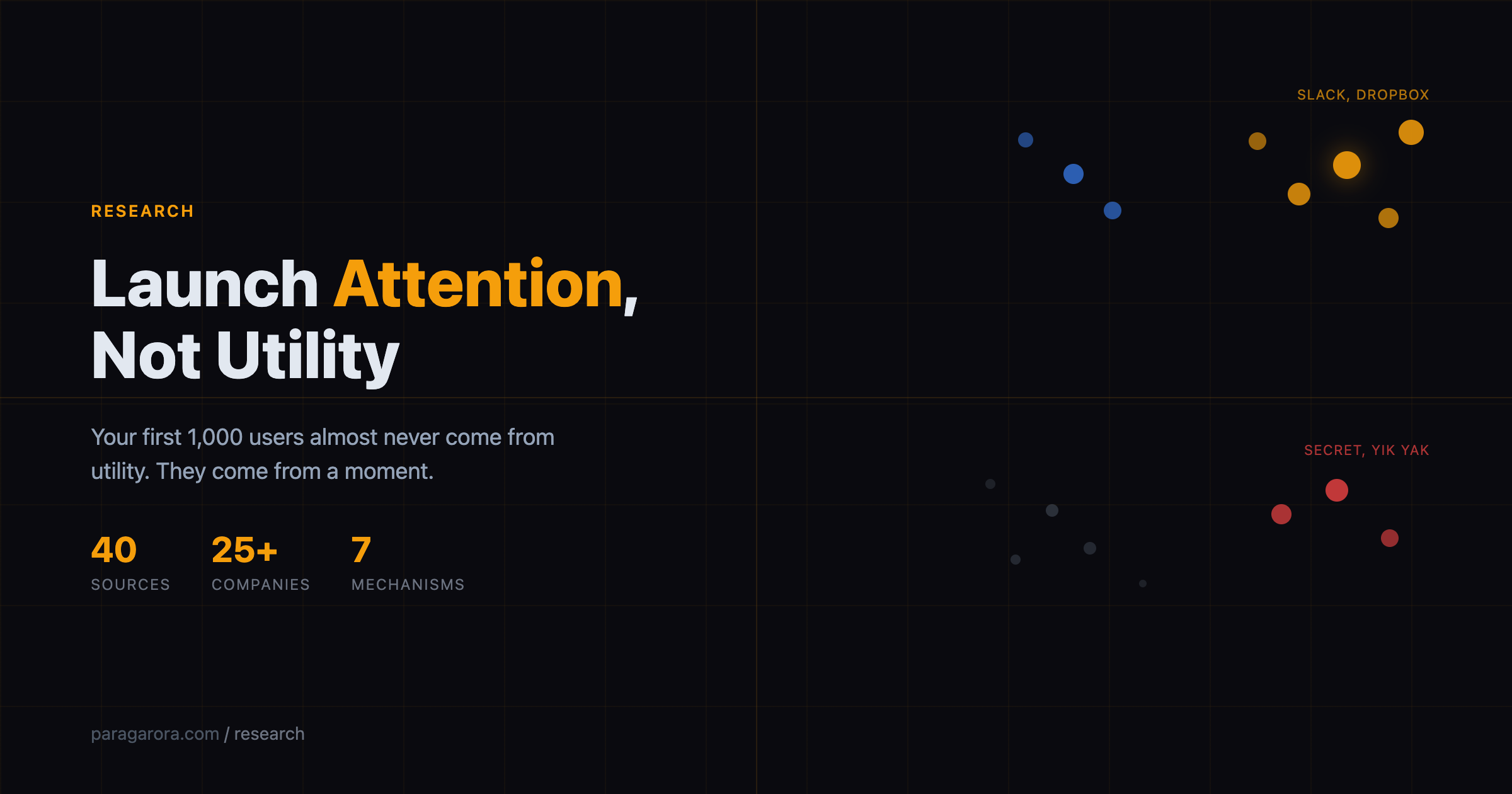
I went deep on this. 40 sources, 25+ companies mapped across four quadrants: high attention and high retention (Slack, Dropbox), high attention and low retention (Secret, Yik Yak), low attention and high retention (Linear, Figma), and the graveyard of well-built products nobody found.
If this was useful, follow me on X for more.
Follow @paragarora on X