The Customer Drift: How Companies Stop Listening After They Raise
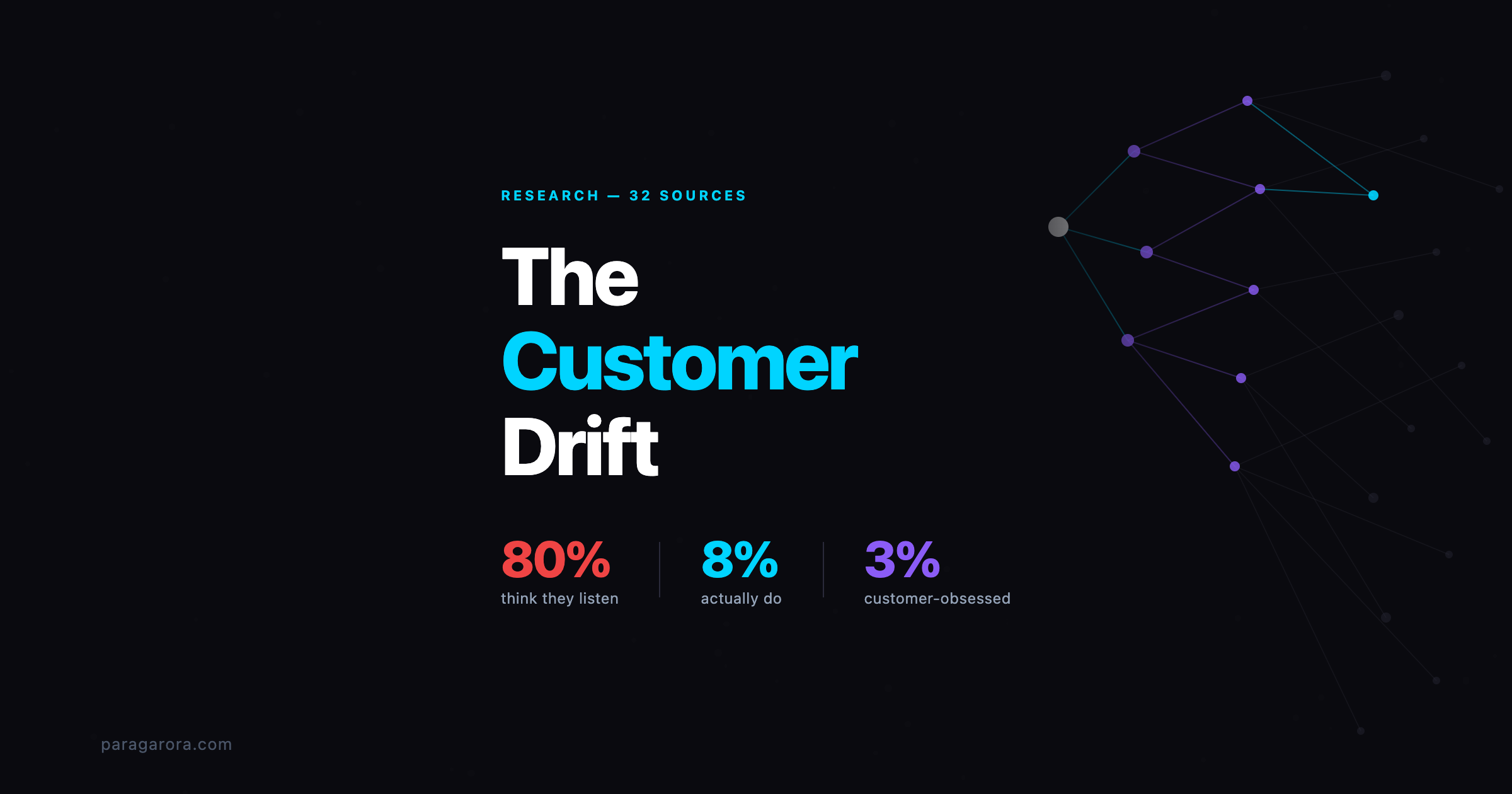
There is a survey result that should embarrass every founder who has ever run a “customer-first” all-hands. Bain asked 362 companies whether they delivered a superior customer experience. 80% said yes. Then Bain asked those companies’ actual customers. 8% agreed.
That is not a perception gap. That is a delusion at scale.
I spent time going deep on this question: do companies actually stop talking to customers after they raise, after they hire, after they scale? The answer across 32 sources is unambiguous. Yes. And the mechanism is largely invisible to the people it is happening to.
The Default Outcome of Growth
Paul Graham wrote “Founder Mode” in September 2024. It got 20 million Twitter views in days. That virality is a signal. Founders recognized themselves in the description: following conventional management advice, adding layers, and gradually losing contact with the actual thing they were building for.
Brian Chesky told Airbnb’s story honestly. He hired well, delegated properly, followed every rule in the management playbook, and watched the company suffer. When he restructured, centralized decisions back to himself, and personally reviewed all customer-facing work, revenue went from zero to $6 billion in 2021 and nearly $10 billion by 2023.
The lesson is not “micromanage.” The lesson is that organizational layers do not scale customer signal. They filter it, delay it, and eventually replace it with internal metrics that require no customer contact at all.
Steve Blank built his entire Customer Development methodology because he had already failed by staying inside. His first principle: “There are no facts inside your building.” He made it a principle precisely because every organizational instinct runs the other direction.
What the Numbers Actually Say
The Forrester data is worth sitting with. In 2021, 10% of companies qualified as genuinely customer-obsessed by their definition. By 2024: 3%. This is not a COVID anomaly. This is a trend line moving in the wrong direction despite a decade of CX initiatives, NPS dashboards, and Chief Customer Officer hires.
The companies that stay close to customers do not just feel better about themselves. They grow revenue 41% faster. Profit 49% faster. They retain customers 51% better. The premium is enormous.
The penalty for drifting is equally real. BlackBerry held 50% US market share. Then they stopped listening to how smartphones were being used and defended assumptions instead of updating them. Three years later: under 5% global share. Nike eliminated 70% of its category experts in favor of data analytics and watched digital sales fall 26% year-over-year in Q4 2024. Andrew Mason, Groupon’s founder, was fired and wrote his own dismissal letter. In it, he said he wished he had “had the courage to start with the customer.”
The Structural Trap
Here is what makes this hard: none of the drift is malicious. Nobody decides to stop listening. The mechanism is structural.
Customer success teams are hired to “scale relationships.” Sales layers are added to “grow efficiently.” Product managers are hired to “synthesize feedback.” Each addition is described as a way to get closer to customers. Each one inserts distance. The founder who once took support calls at 3 AM now receives a weekly digest of aggregated feedback themes. The signal has been processed into something manageable, and in that processing it has been stripped of everything that was actually useful.
Brett Kopf, who grew Remind to 35 million users, said it directly: “I didn’t talk to my customers enough. I couldn’t truly say who they were.” He is not describing a crisis moment. He is describing a default mode that felt normal.
Ivan Zhao at Notion receives a personal phone notification every time a support request comes in. At 100 million users and a $10 billion valuation. He keeps the notifications. More: when a feature ships that a customer requested, Notion personally notifies that customer. “Hey, remember you asked for this a year ago? Now we released it.” Zhao’s observation about this practice: “No software company does this.”
The companies that fight the drift do not do it by accident. They build structural countermeasures: Bezos’s empty chair at every meeting, Chesky’s personal weekly reviews, Zhao’s notification system. The countermeasures exist because the drift is the default.
What Founders Forget After the Raise
Y Combinator’s top-of-mind advice across 4,000+ funded companies: write code and talk to users. The repetition of that advice is itself the evidence. If founders naturally kept talking to customers, YC would not need to keep saying it.
After a raise, the pull away from customers accelerates. There are new board members who want strategy, not customer call summaries. There are new hires who are supposed to “own” customer relationships. There are dashboards. There are metrics. The founder’s calendar fills with internal meetings, and somewhere in that filling, the customer conversations become something to delegate.
Jason Lemkin puts it plainly: the amount of time a CEO spends in direct customer conversations never goes down as the company scales. Not at $10M ARR, not at $100M ARR, not at $200M ARR. The role changes but the contact does not. The fact that Lemkin has a large audience for this argument tells you that the default behavior is the opposite.
Rahul Vohra at Superhuman built customer contact into a weekly scoring system. By asking users whether they would be “very disappointed” if they could no longer use the product, tracking the score weekly, and using customer conversations to move the number, Superhuman went from 22% to 58% on the Sean Ellis threshold that separates companies that grow easily from companies that struggle. Product-market fit, he concluded, is not discovered once. It requires continuous active maintenance.
The Research
I went deep on this with 32 sources spanning academic research, founder interviews, industry surveys, and documented corporate failures. The full analysis, with the data visualized as a live network that degrades in real time as organizational layers build up between founder and customer, is here:
Read the full research: The Customer Drift
The visual is worth opening. It shows exactly what happens to the founder-customer connection as a company adds layers. The network does not break dramatically. It just slowly goes dark.
The 80/8 gap is not an outlier. It is the median. Most companies have lost meaningful contact with the people they are building for, and the leaders of those companies do not know it because the feedback they receive has already passed through too many layers to reflect reality.
The question worth asking in your next product review: when did you last talk to a customer who was not on a formal success call, not in a focus group, not filtered through a PM’s synthesis? If the answer is not this week, the drift has already started.
If this was useful, follow me on X for more.
Follow @paragarora on X