The Twitter GTM Playbook: 27 Founders, $1M+ ARR, No Sales Team
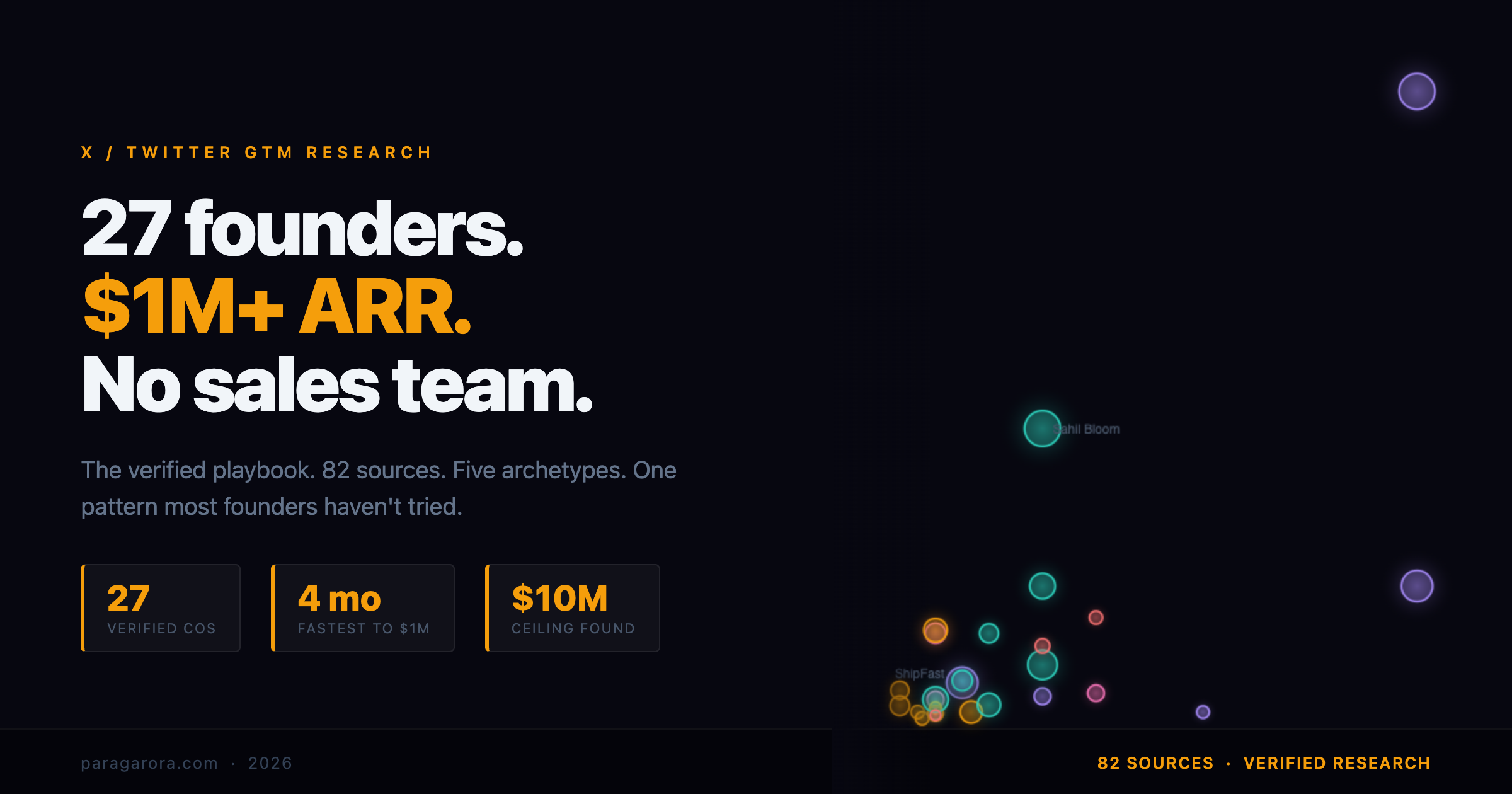
ShipFast hit $1M ARR run rate in four months. Twitter was the only channel.
Papermark’s founder tweeted “I’m going to build an open-source alternative to DocSend.” That tweet got 95,000 views. Today the company has $900K ARR. Total marketing budget: one tweet.
Dickie Bush asked “who wants to write online every day for 30 days?” Six days later: 50 people in a Slack. Year 1 revenue: $1M+. Cost of acquisition: one question.
I spent three weeks verifying 82 sources across the Twitter/X ecosystem to find every company that crossed $1M+ ARR with Twitter as their primary go-to-market channel. Not secondary. Not supplementary. Primary.
I found 27. See the full interactive database and visualization.
What “Twitter GTM” Actually Means
This is not about posting product updates. Every company with a social media manager does that.
Twitter GTM, in the cases that actually work, is a specific structure:
- The founder’s personal account is the distribution channel, not a company account
- Revenue milestones, failures, and experiments are documented publicly
- The audience that follows the build becomes the first customers
- Every feature announcement is simultaneously a marketing event
The mechanism is warm-audience conversion. People who have watched a founder fail and iterate for six months convert at rates no cold channel can approach.
The Five Archetypes
After mapping all 27 companies, five distinct structural patterns emerged:
The Long Compounder builds an audience for years before significant revenue materializes. Pieter Levels’s 40+ failed products over 10 years each added followers. When PhotoAI launched in 2023 to 350K followers, it generated $5.4K in week 1 with zero other channels. The 10-year investment had zero marginal cost for each new launch.
The Velocity Launcher has a small targeted audience (10K-70K) in a high-intent niche and converts them fast. ShipFast. Headlime. SiteGPT. These companies did not have large audiences. They had the right audiences. SiteGPT launched with 10,000 followers and hit $1.14M ARR in 12 months.
The Creator Monetizer builds a content audience first, then asks what that audience wants to buy. Justin Welsh: $5M ARR, zero employees. Sahil Bloom: $10M revenue in 2023. The Twitter audience is not the marketing channel. It is the business.
The Product-Channel Fit Operator builds tools for Twitter users and sells them on Twitter. Tweet Hunter, Typefully, Hypefury. The product and the distribution channel are the same thing. When Tibo Louis-Lucas brought JK Molina in as a co-founder, JK’s 100K followers were warm leads for a Twitter growth tool. Revenue tripled in two weeks.
The Antagonist Launcher picks a public fight with an incumbent. Plausible Analytics: “Friends don’t let friends use Google Analytics.” That tweet hit Hacker News front page and launched a $3.1M ARR privacy-first analytics company. Papermark positioned against DocSend. Antagonism creates clarity and attracts people who share the frustration.
The Counterintuitive Findings
The research surfaced several findings that contradict standard GTM intuition:
Small audiences outperform large ones. SiteGPT launched with 10K followers and hit $1M ARR in 12 months. Many accounts with 100K+ general followers never cross $1M. The developer/indie hacker niche at 10K followers converts at rates a general lifestyle audience at 100K cannot match. Specificity beats scale.
Failed startups are growth hacks. Pieter Levels’s 40+ failed products each generated followers who stayed for the eventual winners. The failure tweets got as much engagement as the success tweets. Documenting failure publicly is counterintuitively one of the highest-ROI moves a founder can make.
One tweet can replace years of SEO. Papermark: one weekend of building after one tweet, $900K ARR. Ship 30 for 30: one question, $1M year 1. The expected value of a well-crafted announcement tweet to a targeted niche audience is not obviously lower than multi-year SEO investment.
There is a ceiling at $5-10M ARR. Above that threshold, Twitter-primary companies consistently add other channels. This is not a failure. It is structural. Warm audiences are finite. Beehiiv ($30M ARR), ConvertKit ($36M ARR), Linear ($100M revenue) all used Twitter as one channel among several, not the primary driver. Twitter may be the best 0-to-$5M channel that exists. It is not designed for $5M-to-$50M.
The Platform Risk No One Talks About
Tony Dinh’s Black Magic had $100K ARR and was growing. Then Twitter raised its API price to $42,000 per month. He sold it for $128K.
There is a critical distinction in this dataset. Using Twitter for distribution (posting, building audience, launching products) carries near-zero platform risk. Building a business that depends on Twitter’s infrastructure (API data, algorithmic amplification, Twitter login) creates existential exposure to platform decisions.
Every company in the verified list that survived and scaled did so because their product lived outside Twitter. Twitter was the acquisition channel, not the infrastructure.
The Playbook
Based on 27 verified companies, the sequence that works:
Phase 1: Pick a niche active on Twitter with high intent (developer tools, indie hacking, creator economy, AI, finance). Post about your expertise, not your product. Daily. Build 1,000-5,000 followers who are potential customers.
Phase 2: Start building and tweet every step. Not just wins. The failures and experiments especially. The audience you build is the audience you’ll sell to.
Phase 3: Engineer a launch event. One announcement thread. Limited-time offer. Public promise. The followers who watched you build are warm leads at this moment. Convert them.
Phase 4: Every feature becomes a tweet. Every revenue milestone becomes a tweet. The product roadmap and the content calendar are the same document.
Phase 5: Add SEO or enterprise sales at $3-5M ARR while Twitter is still growing. The warm audience is finite. Plan the transition before you hit the ceiling, not after.
Why Most Founders Don’t Start
The standard explanation is that Twitter requires time. This is true but incomplete.
The more accurate explanation: Twitter GTM requires founders to be publicly wrong, publicly vulnerable, and publicly accountable in ways that most professional contexts train people to avoid. The build-in-public requirement is not a content strategy. It is a personality type.
The companies that succeeded were built by founders who were comfortable with public failure. Who treated their audience as collaborators rather than customers. Who posted revenue screenshots before the numbers were impressive. Who asked for feedback before the product was ready.
This is available to anyone with an internet connection.
Most founders have not started yet.
This post is based on 82 sources across the Twitter/X ecosystem. The full report includes the complete 27-company database, tactic breakdown, and interactive visualization.
Explore the full research: interactive viz, 27-company database, and complete report
If this was useful, follow me on X for more.
Follow @paragarora on X