The YC Batch That Changed Everything
W22 was YC’s largest batch ever. 414 companies. 50% international founders. The first batch with a $500K deal. YC had never been more ambitious.
Today, 90+ of those companies are confirmed inactive. The real number is higher.
The funding winter that began in late 2022 did not discriminate. It hit exactly the categories W22 had over-indexed on: lightweight SaaS, fintech experiments, consumer platforms, first-generation AI wrappers with no moat. The $500K deal gave them more runway into a market that had been repriced for a different era.
That is the setup for this research. W22 is the graveyard generation. But the story does not end there.
One Number
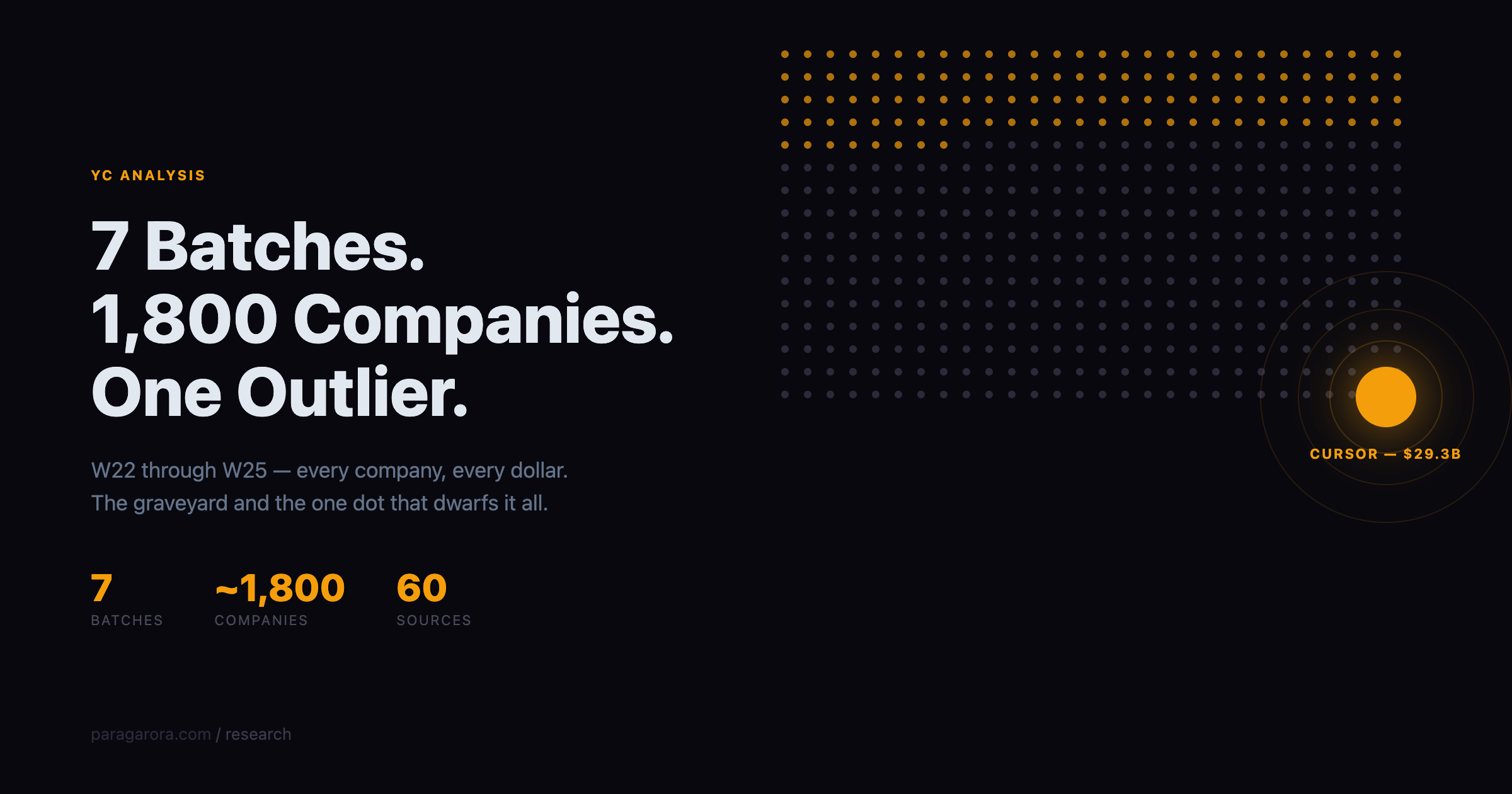
Cursor/Anysphere graduated from W23. Today it is valued at $29.3 billion with over $1 billion in ARR.
The entire W22 batch cannot match that number. 414 companies — YC’s most ambitious cohort — cannot collectively match one company from the next batch.
This is not a success story about YC. It is a distribution story. The outcomes from this era are not spread across 1,800 companies. They are concentrated in one or two founders who were right about one thing: which specific layer of AI would matter, before it was obvious.
Cursor bet on the IDE layer. Not AI as a feature bolted onto an existing editor. The editor rebuilt from the ground up with AI as the first-order design principle. They made that bet in W23, before the category had been confirmed, before the valuation multiples had been set, before it was obvious.
The AI Shockwave Was Not Gradual
Between S22 and S23, the AI share of YC’s batch went from 15% to 57%. In one application cycle. Six months.
The mechanism: GPT-4 launched March 14, 2023. S23 applications closed approximately six weeks later. Founders who applied to S22 had seen GPT-3.5. They knew AI was interesting. Founders who applied to S23 had seen GPT-4. They knew AI was real. That gap — one product release, six weeks — restructured the entire composition of the world’s most important accelerator.
By W24, 70% of the batch was AI. By W25, the question was no longer “is this AI?” It was “which specific layer, which moat, why won’t GPT-5 make this irrelevant?”
The Correction That Matters
Perplexity AI is consistently cited as a W23 company. It is not. Perplexity was founded in August 2022 and funded by Elad Gil, NEA, IVP, and Nvidia. Garry Tan and Daniel Gross personally invested in Perplexity’s Series C — as individuals, not via YC. That is the source of the confusion.
This matters because Perplexity at $20B is often cited alongside Cursor to make W23 look like it produced two category-defining companies. It produced one. Cursor alone at $29.3B is already the greatest batch outcome concentration in YC’s modern history. The correct version of the story is actually more interesting than the misattributed one.
What the Winners Had in Common
Every top-valued company from this era — Cursor, LangChain, Warp, Mem0, Browser Use — built infrastructure. Not applications. Not features. Layers.
The reason is structural: applications built on top of foundation models face a specific risk. The foundation model improves and the application becomes redundant. Infrastructure that sits between the model and the application is harder to displace. Once LangChain is embedded in production AI workflows, replacing it requires rewriting the stack. Once Cursor is the editor a team has built muscle memory around, switching requires deliberate effort.
Infrastructure compounds. Applications race. The founders who understood this — and bet on it before the category was confirmed — are the ones who built the companies that matter from this era.
What YC Quietly Became
One finding that did not make the headlines: YC went from 50% international founders in W22 to 10% by W25. Garry Tan reversed the pandemic-era distributed model and rebuilt YC around physical presence in San Francisco. The world’s accelerator became a zip code.
Whether that tradeoff was correct depends on whether W23 onward produces better outcomes per company than the distributed era. The early data is supportive. But the outlier problem makes it hard to know — W23 looks exceptional because of Cursor, not because of the average company in the batch.
I went through every batch, every company I could find data on, 60 sources. Full analysis with interactive visualization below.
Read the full research: every batch, every top raiser, the graveyard, the patterns
If this was useful, follow me on X for more.
Follow @paragarora on X